Men BMI chart in inches and lbs for Late Middle Aged Adults 55 years old
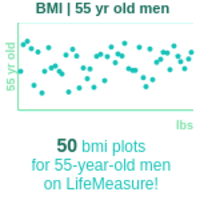
General Summary: 55 year old men BMI
In most cases, BMI measurements for 55 year old men will be in the range between 23 and 41 inches and lbs. The average BMI for 55 year old men is 32 inches and lbs, according to the CDC and anonymized data from users.All Results
Enter your BMI measurements above to see how they compare
So far, we have recorded 0 BMI measurements for 55-year-old men on LifeMeasure!
(chart updates daily)
BMI chart for 55-Year-Old men
Tracking BMI percentiles for men at 55-Year-Old.
BMI percentiles for 55-Year-Old men
According to CDC growth chart data, here is how BMI breaks down for men at 55-Year-Old:
5th percentile: 22.0
25th percentile: 24.9
50th percentile (median): 27.5
75th percentile: 31.2
95th percentile: 36.8
The percentile values on this page are displayed in inches and lbs.
For adults, the standard BMI categories are: underweight below 18.5, healthy weight 18.5-24.9, overweight 25.0-29.9, and obese 30.0 and above.
Growth chart percentiles describe where your measurement sits among men measured in the CDC reference study. At the 50th percentile, the measurement is right at the middle of the typical range.
BMI and development for men
In the fifties, maintaining a healthy BMI requires active management of metabolic changes as muscle mass gradually declines and resting metabolic rate slows. At 55, the most effective approaches are increasing protein intake to preserve muscle, reducing sedentary time, and maintaining structured exercise including both aerobic and resistance training.
Long-term BMI management in midlife
In middle age, BMI management benefits most from a long-term perspective. Crash dieting or extreme caloric restriction typically results in muscle loss alongside fat loss, which can worsen metabolic health despite a lower number on the scale. The most effective approach is a moderate caloric deficit combined with resistance training to preserve muscle.
The role of resistance training
Resistance training twice or more per week is the most effective intervention for maintaining lean muscle mass as metabolic rate naturally declines in middle age. Higher muscle mass supports a higher resting metabolic rate, making weight management progressively easier. Even modest loads - bodyweight exercises, resistance bands, or light weights - produce measurable benefits.
Frequently asked questions
What are the limitations of BMI as a health measure?
BMI does not distinguish between muscle and fat, does not account for where fat is distributed in the body, and can misclassify individuals with high muscle mass (appearing overweight) or those with low muscle mass and high fat (appearing normal weight). Waist circumference, waist-to-height ratio, and in some cases body composition measurement provide complementary information to BMI for a more complete picture.
How is adult BMI calculated?
BMI is calculated by dividing weight in kilograms by height in metres squared (kg/m2). A person who weighs 80 kg and is 1.75 m tall has a BMI of 80 / (1.75 x 1.75) = 26.1. The calculation is the same for all adults regardless of age or sex, though the health implications of a given BMI value vary somewhat between populations and life stages.
Does BMI change meaning with age for adults?
For adults under 65, the standard BMI categories (underweight, healthy, overweight, obese) are broadly applicable. For adults over 65, research suggests the relationship between BMI and health outcomes shifts - a slightly higher BMI may be protective in older age, and body composition (particularly muscle mass) becomes more clinically relevant than BMI alone. Healthcare providers can advise on appropriate targets at each life stage.
Data sources and methodology
The percentile ranges on this page are drawn from CDC National Health and Nutrition Examination Survey (NHANES) data, Vital and Health Statistics Series 3 Number 46 (2021-2023 release), and CDC Body Measurements FastStats. Percentiles are modelled using the LMS method (Box-Cox transformation), which accounts for the skewed distribution of measurements at each age. All measurements are given in metric units with imperial equivalents.
For personalised guidance, consult a paediatrician or healthcare provider who can assess your measurements in the context of their full growth history.
See more ages