Boys Weight chart for Children 7 years & 7 months old
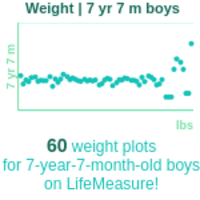
General Summary: 7 year & 7 month old boys weight
In most cases, weight measurements for 7 year & 7 month old boys will be in the range between 42 and 77 lbs. The average weight for 7 year & 7 month old boys is 54 lbs, according to the CDC and anonymized data from users.All Results
Enter your weight measurements above to see how they compare
So far, we have recorded 0 weight measurements for 7-year-7-month boys on LifeMeasure!
(chart updates daily)
Weight chart for 7 Years 7 Months boys
Understanding weight patterns for boys at this stage of development.
Weight percentiles for 7 Years 7 Months boys
Based on CDC and WHO reference data, weight percentiles for boys at 7 Years 7 Months are:
5th percentile: 19.7 kg (43.4 lbs)
25th percentile: 22.2 kg (48.9 lbs)
50th percentile (median): 24.4 kg (53.9 lbs)
75th percentile: 27.3 kg (60.1 lbs)
95th percentile: 33.0 kg (72.8 lbs)
Growth chart percentiles describe where your child's measurement sits among boys measured in the CDC reference study. At the 50th percentile, the measurement is right at the middle of the typical range.
Weight and development for boys
At 7 years old, children typically gain around 2-3 kg per year. School entry at age 5 brings structured physical education and active play opportunities that support healthy weight patterns. Nutrition at this age should include plenty of vegetables, whole grains, lean protein, and dairy, with limited ultra-processed foods. Sleep needs for 7 year olds are 9-11 hours per night, and adequate sleep is directly linked to healthy weight regulation through its effects on appetite hormones.
Family habits that support healthy weight
For primary school-age children, the most evidence-based supports for healthy weight are regular family meals, adequate sleep (9-11 hours for ages 6-12), at least 60 minutes of moderate to vigorous physical activity daily, and limited ultra-processed food and sugary drinks.
Talking about weight with children
Avoid discussing weight, body size, or dieting in front of children - research links this to higher rates of disordered eating in adolescence. If a GP or school nurse identifies a weight concern, framing any lifestyle changes in terms of energy, strength, and wellbeing is more effective and less harmful than weight-focused messaging.
When to involve a health professional
If you have concerns about a child's weight, the school nurse or GP is the appropriate first point of contact. They can assess whether the pattern is concerning in context of the full growth history and refer to a paediatric dietitian or specialist if needed.
Frequently asked questions
Should I be concerned if my child's weight has stayed the same for a few months?
Brief weight plateaus are common in growing children and are usually not a cause for concern if the child appears healthy, has a good energy level, and is growing in height. A plateau of 3 months or more, particularly if accompanied by any health concerns or a fall across percentile lines, is worth discussing at the next GP or child health check.
What is a healthy weight for this age?
The percentile table on this page shows the full range of typical weights. All values from the 5th to the 95th percentile are within normal limits. Weight at a single point in time is less informative than a consistent growth pattern - a child who has always been at the 25th percentile and remains there is growing normally.
How much weight does a child gain per year?
After infancy, the rate of weight gain slows considerably. Toddlers typically gain 1.5-2 kg per year, preschoolers around 2 kg per year, and school-age children 3-5 kg per year. During puberty, the rate accelerates significantly - 4-8 kg per year is common during the peak growth phase.
Data sources and methodology
The percentile ranges on this page are drawn from CDC growth chart data from the National Center for Health Statistics and WHO Child Growth Standards (for children under 5). CDC data published May 30, 2000, with 2022 extended BMI tables. Percentiles are modelled using the LMS method (Box-Cox transformation), which accounts for the skewed distribution of measurements at each age. All measurements are given in metric units with imperial equivalents.
For any concerns about growth or development, consulting a registered health professional who has access to the full growth record is always recommended.
See more ages